
EUDR (deforestation regulation): what’s changes for cocoa
In three months, the EU Deforestation Regulation (EUDR) applies to cocoa. From 30 December 2026, every large or medium-sized company placing cocoa or chocolate on the EU market must prove it does not come from land deforested after 2020.
Twoments postponed, in 2024 and 2025, created the impression of a text that keeps slipping. This time, the Commission has ruled out any further amendment. The date holds, and the data required concerns plots being farmed today.
This article answers four questions. Who is covered, and from when? What did the December 2025 revision change? Why do Ghana and Côte d’Ivoire, neighbors that together supply two thirds of the world’s cocoa, fall under different regimes? And what should operators do before the deadline?
The analysis draws on FOSACOR’s regulatory monitoring in food law and food safety, with a particular focus on food trade between the EU and Africa.
The EUDR, Regulation (EU) 2023/1115, prohibits placing cocoa and its derived products on the EU market, or exporting them, unless they are deforestation-free after 31 December 2020, legally produced and covered by a due diligence statement. It applies from 30 December 2026 to large and medium-sized companies and from 30 June 2027 to micro and small ones.
Every week, FOSACOR decodes one regulatory change that affects your labels, contracts or exports. Get each analysis as soon as it is published: subscribe to the newsletter.
Regulatory context: what the EUDR requires for cocoa
Regulation (EU) 2023/1115 of 31 May 2023 covers seven commodities, including cocoa and its derived products: beans, paste, butter, powder and chocolate.
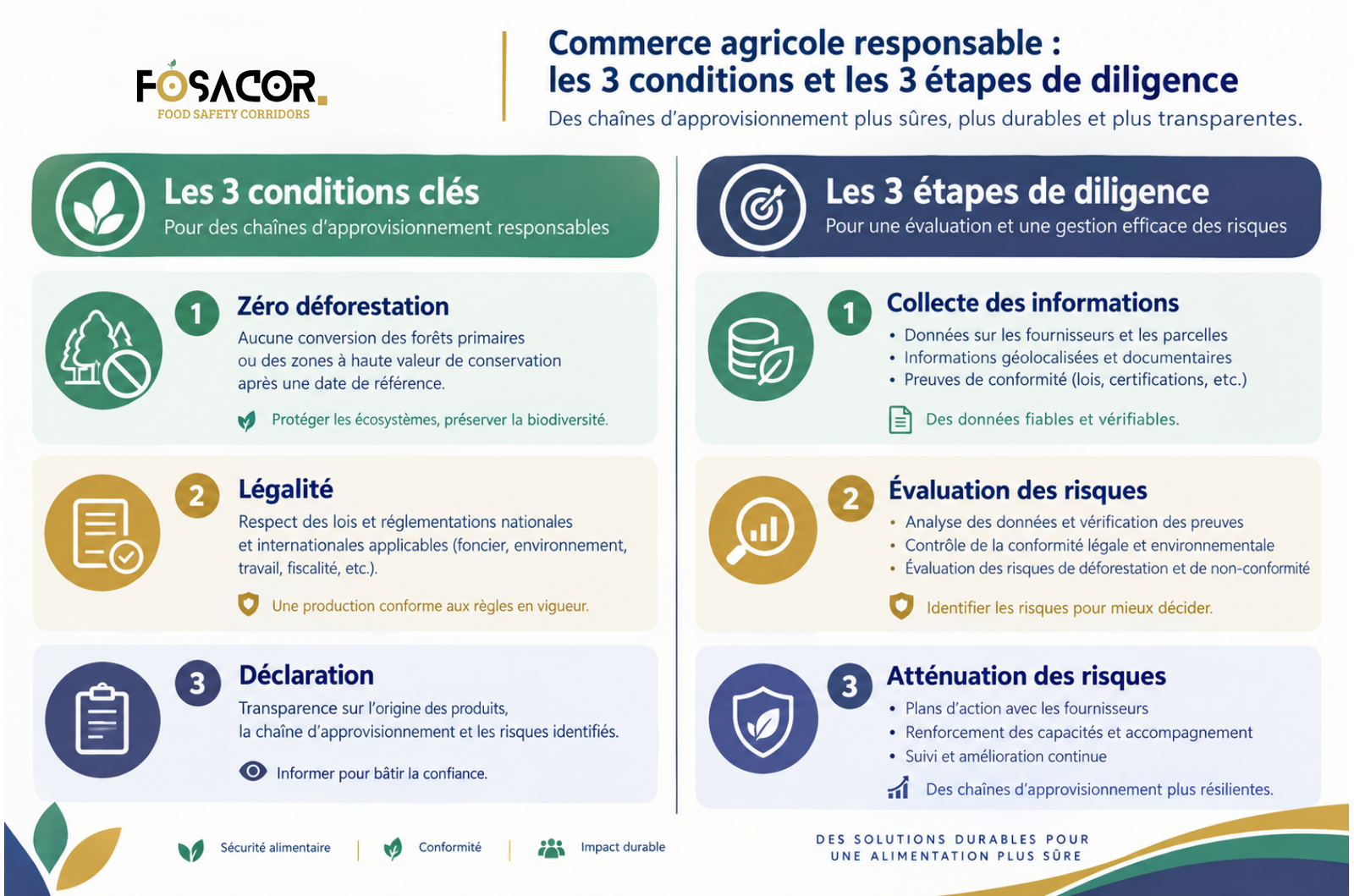
It sets three cumulative conditions: no deforestation after 31 December 2020, production in line with the law of the country of origin, including land tenure and labour, and a due diligence statement filed before placing on the market.
Due diligence has three steps: collect information, including plot geolocation; assess the risk; mitigate it unless it is negligible.
Regulation (EU) 2025/2650 of 19 December 2025 fixed the dates: 30 December 2026 for large and medium-sized companies, 30 June 2027 for micro and small companies established as such by 31 December 2024. It concentrates the statement on the first operator placing the product on the market; downstream actors keep the reference numbers.
In its report of 4 May 2026, the Commission ruled out any further amendment of the basic act. The acts adopted on 13 July 2026 adjust the information system and the scope.
Delegated Regulation (EU) 2026/2102, in force since 18 September 2026, keeps all six cocoa headings (1801 to 1806). It does, however, exclude from heading 1802 (cocoa shells, husks, skins and other cocoa waste) waste within the meaning of Directive 2008/98/EC. The third edition of the guidance was published in the Official Journal on 20 July 2026.
Penalties are severe: a maximum fine of at least 4% of EU turnover, confiscation of products and exclusion from public procurement (Article 25). Penalty regimes remain national: in France, for instance, the competent authority is shared between the environment and agriculture ministries, but no national penalty regime had been published as of 8 October 2026.
FOSACOR analysis: two neighbors, one bean, two regimes
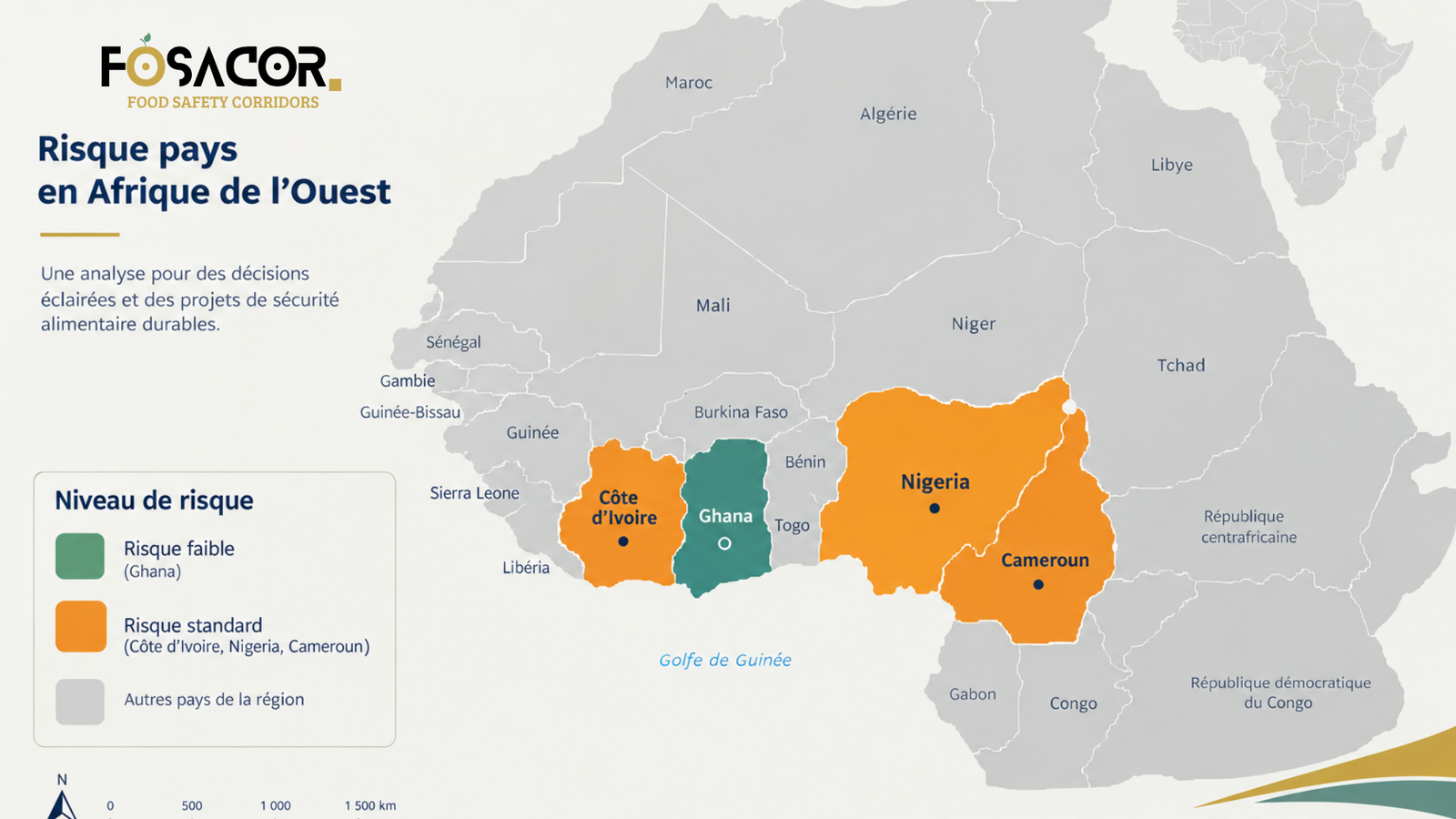
Implementing Regulation (EU) 2025/1093 classifies Ghana as low risk. Côte d’Ivoire, Cameroon and Nigeria fall under standard risk, the default category. No major cocoa producer is classified as high risk.
Practitioners often confuse two reliefs. Simplified due diligence under Article 13 benefits any operator sourcing exclusively from low-risk countries: it removes risk assessment and mitigation, not data collection, geolocation included.
The micro or small primary operator regime under Article 4a is reserved for producers established in low-risk countries. A single simplified declaration replaces repeated statements. The postal address of the plots, or of the production establishment, can replace their geolocation (Article 4a(5)).
The regime assumes that the operator itself places its own harvest on the EU market (Article 2, point (15a)). It mainly benefits EU farmers: a Ghanaian smallholder selling to a licensed buying company is not an operator under the Regulation.
Importers of Ghanaian cocoa must therefore geolocate, just as for Ivorian cocoa. The gap lies in risk assessment and the frequency of checks. It is a threshold effect, not a sanction, based on quantitative deforestation indicators.
The classification also drives official checks (Article 16): at least 1% of operators for low risk, 3% for standard risk, and 9% of operators and of quantities for high risk.
One lesson stands out: postponement changes the date, never the obligation. Proof of land legality covers a plot for years. A company building its file now accumulates evidence; one that waits will have to produce everything at once, for a harvest already gathered.
What the science says
Research confirms that the challenge is first and foremost a data problem.
Kalischek et al. (2023, Nature Food) note that Côte d’Ivoire and Ghana supply two thirds of the world’s cocoa. Cocoa drives more than 37% of forest loss in Ivorian protected areas, and more than 13% in Ghana, despite its low-risk status.
Renier et al. (2022, Environmental Research Letters) show that in 2019 only 43.6% of Ivorian exports could be traced to a cooperative; farm-level traceability lagged further behind.
Celik et al. (2026, Environmental Research Letters) show that farms under 2 hectares supply 60% of cocoa grown in forested landscapes. They place Côte d’Ivoire among regions at high risk of exclusion and point to a mismatch between country benchmarking and actual deforestation exposure.
Evidence itself has limits. Bourgoin et al. (2026, Earth System Science Data) assess the EU’s 2020 reference forest map: 91% overall accuracy, yet almost one « forest » pixel in five is not forest. In Cameroon, Ingram et al. (2025) found 64% of observed cocoa farms mapped as forest.
The practical consequence: a satellite alert is not proof. Keep dated field evidence, especially for cocoa agroforestry plots established before 2021.
Impact opérationnel
Regional focus: Ghana, Nigeria and the West African corridor
For West African supply chains, compliance becomes a data problem before it is an agronomic one. Costs move upstream, where resources are thinnest.
National systems are advancing. In Côte d’Ivoire, the producer card has been mandatory since 1 September 2026, under the Decree No. 2023-723 of 13 September 2023 establishing the national traceability system; more than 900,000 cards have been issued. Ghana had already mapped 1.2 million cocoa farms by 2023.
In Cameroon, authorities claimed 70 to 80% of production as traceable, but the EFI estimated only about half of traded cocoa as geolocated, mostly through certified supply chains. Geolocation remained on hold in the anglophone South-West, which accounts for 30% of volumes. These systems help, but they do not shift the EU operator’s responsibility. Nigeria and Cameroon, at standard risk, face the same full regime as Côte d’Ivoire.
The African standard ARS 1000, mandatory in Côte d’Ivoire since a 2022 decree, supports due diligence without replacing it: its reference date (June 2021) and forest definition differ from the EUDR. Neither ECOWAS, WAEMU nor the African Union imposes an equivalent rule.
The United Kingdom has not yet made its regime operational: expected in 2027, it targets only illegal deforestation, while Northern Ireland will apply the EUDR. The same bean can therefore face different regimes depending on its destination.
Conclusion
For cocoa, the EUDR does not add one more certificate. It changes the unit of traceability: the question is no longer who you bought from, but which plot the material came from.
The calendar is now set: 30 December 2026 for large and medium-sized companies, 30 June 2027 for smaller ones, with no further postponement in sight.
The Ghana and Côte d’Ivoire classification shows that the gap lies not in the quality of the bean but in the depth of due diligence required. For an importer, the question is not « is my cocoa compliant? » but « can I prove it, batch by batch? ».
Those who equip the producer’s data will capture compliance, and with it the commercial relationship. Support for geolocation now conditions access to the EU market more surely than product quality.
One question remains for every buyer: for the cocoa you will place on the market on 30 December, do you know today which plot it comes from?
Do you import, process or export cocoa? FOSACOR qualifies your role under the EUDR, maps your origins and builds your due diligence file with you. Write to us: contact@fosacor-group.com.
Calendrier et régimes EUDR pour le cacao
| Situation | Deadline | Diligence | Origin data required |
|---|---|---|---|
| Large or medium-sized company placing cocoa on the market | December 30, 2026 | Full; simplified (Art. 13) if all origins are low risk | Plot geolocation |
| Micro or small company established by December 31, 2024 | June 30, 2027 | Full or simplified, depending on origins | Plot geolocation |
| Micro or small primary operator in a low-risk country, selling its own harvest in the EU | June 30, 2027 | Single simplified declaration (Art. 4a) | Postal address possible |
| Origin in a standard-risk country (Ivory Coast, Cameroon, Nigeria) | Depends on operator size | Full | Plot geolocation |
| Downstream operator or trader | Depends on size | No systematic statement; keep references | Upstream reference numbers |
This article provides a general analysis based on FOSACOR’s research and expertise in food law and food safety management. Every operational situation is unique: the implications for your company, market or jurisdiction deserve a tailored analysis.
Contact FOSACOR’s experts.